


Design by who? The City

uau studio developed a custom AI software platform that seamlessly connects multiple artificial intelligence systems, transforming hand-drawn sketches into three-dimensional architectural models through an automated, real-time workflow. Every participant's design becomes a building within a growing digital city, collectively shaped through shared creativity.
.png)
The Process
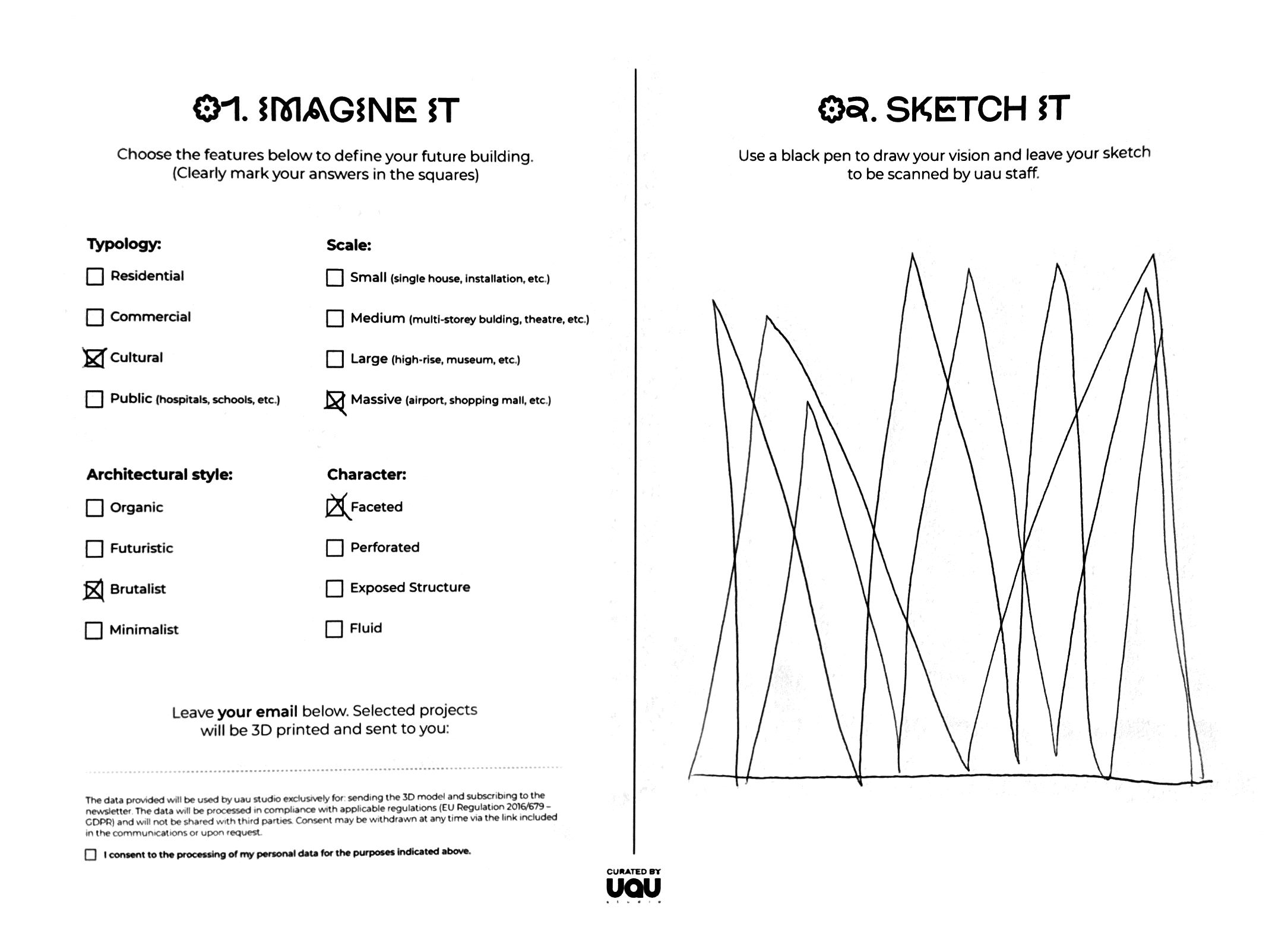
uau studio developed a custom software infrastructure connecting multiple artificial intelligence systems, enabling the transformation of a hand-drawn sketch into a three-dimensional architectural model. Visitors received a specially designed A4 sheet divided into two sections. In the first section, participants selected a series of predefined architectural characteristics for their ideal building — including scale, typology, materiality, and aesthetic language. In the second section, they freely sketched their vision by hand. Once completed, the sheet was scanned via smartphone. An AI system interpreted the selected options and converted them into a structured prompt.

This information was then combined with the visitor’s drawing and processed through a second AI model capable of generating a visual interpretation and transforming it into a 3D object.Each resulting building was automatically inserted into a continuously growing digital city composed entirely of visitor-generated architectures. The entire internal workflow was automated through custom Python scripting, allowing the process to happen in near real time throughout the exhibition.
Designing the A4 Input Sheet
To ensure a seamless automated workflow, the A4 sheet was carefully standardized so the system could accurately read and process every contribution. The layout was divided into two main areas: a structured selection panel on the left and a framed drawing area on the right. The selection panel allowed participants to define specific architectural parameters through a series of visual categories and checkboxes. The configurable attributes included: typology, scale, architecture style and character. This hybrid system allowed visitors to combine rational architectural decisions with intuitive freehand expression, generating a rich variety of design outcomes while maintaining a readable structure for the AI pipeline.
How AI interprets the drawings
The digitization and 3D generation process was managed through a custom computational pipeline. By combining computer vision, artificial intelligence and automated processing, the system transformed hand-drawn sketches into three-dimensional architectural models within seconds, creating a seamless dialogue between human intuition and machine interpretation.

The City
Each generated architectural model was automatically integrated into a shared digital city through a custom computational system. As new buildings were created, they were imported, proportionally adapted and assigned to an available plot within a predefined urban layout, allowing the installation to expand continuously throughout the exhibition.


The result was a living architectural landscape, where every visitor's contribution became part of a collective urban vision, revealing how individual ideas can merge into a constantly evolving city.

Final Outcome
The final installation evolved into a dense and constantly growing urban landscape composed entirely of unique buildings generated from visitor contributions. No structure was identical to another. Towers stood beside minimal houses, organic forms emerged next to brutalist volumes, and speculative futuristic architectures coexisted with simple human sketches. The city became the physical manifestation of collective imagination — an evolving archive of thousands of individual ideas merged into one shared architectural ecosystem.

uau design team
Gianluca Santosuosso, Mateusz Sak, Rania Hanafy, Martina Galbo
Heading 1
Heading 2
Heading 3
Heading 4
Heading 5
Heading 6
Lorem ipsum dolor sit amet, consectetur adipiscing elit, sed do eiusmod tempor incididunt ut labore et dolore magna aliqua. Ut enim ad minim veniam, quis nostrud exercitation ullamco laboris nisi ut aliquip ex ea commodo consequat. Duis aute irure dolor in reprehenderit in voluptate velit esse cillum dolore eu fugiat nulla pariatur.
Block quote
Ordered list
- Item 1
- Item 2
- Item 3
Unordered list
- Item A
- Item B
- Item C
Bold text
Emphasis
Superscript
Subscript